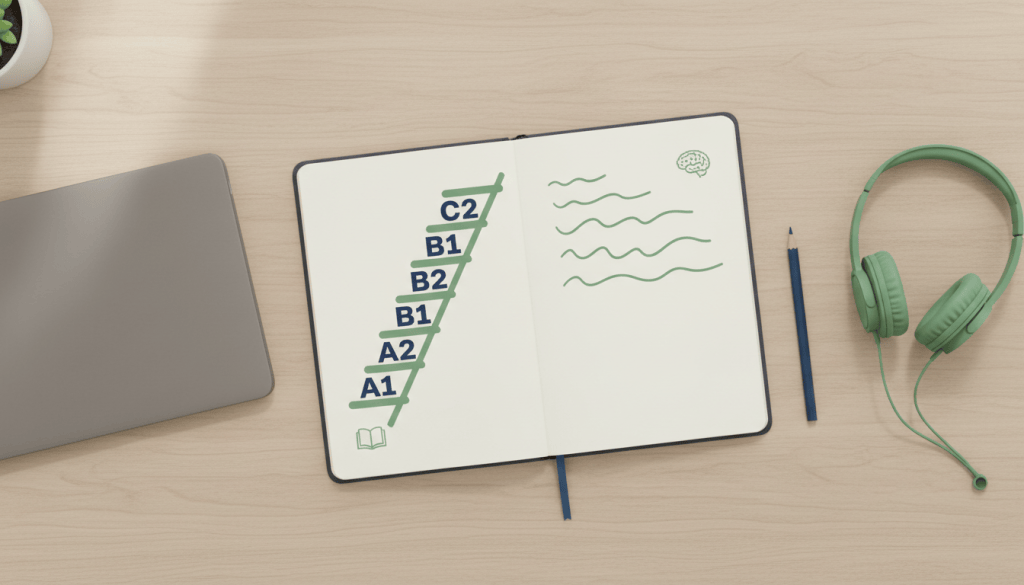
You have found a promising language course, but the enrolment form asks for your level. Are you A2, B1 or B2? Perhaps a free online quiz tells you that you are B2, even though speaking to another person still feels difficult. Or perhaps a school asks you to pay for a placement test before it will recommend a class.
The short answer is this: a placement test is a starting point for choosing suitable learning material, not a complete verdict on your ability. Check which skills it measures, compare its result with what you can actually do, and ask the course provider to explain how the result determines your class. A free quiz can be useful; a longer assessment with a speaking component may be more useful for a conversation-based course. Neither should automatically be treated as an internationally accepted qualification.
This guide explains the different kinds of test, how to interpret a Common European Framework of Reference for Languages (CEFR) level, how to spot a poor course match and how to make a decision without paying for something you do not need. The examples are practical illustrations, not promises about any provider’s outcomes. Provider information and links were rechecked on 2 November 2026.
First decide what question you need the test to answer
People use the phrase “language test” for several different purposes. A placement test asks, “Which class should I join?” A progress check asks, “What have I learned since last month?” A diagnostic assessment asks, “Which particular skills need attention?” A formal proficiency examination asks, “Can I demonstrate a recognised level to an employer, university or public authority?”
These purposes overlap, but they are not interchangeable. A ten-minute vocabulary quiz might be enough to suggest beginner or intermediate practice material. It would be a weak basis for certifying that someone can negotiate professionally, deliver a presentation or satisfy a visa requirement. Equally, you do not need to pay for a recognised examination merely to decide which free listening exercises to try.
Before taking a test, write down one sentence: “I need this result to help me ______.” If your answer is “choose a weekly group course”, ask how that particular school places learners. If your answer is “prove my English for a university application”, check the university’s current accepted tests and score requirements instead. This distinction can save considerable time and money.
What do A1, A2, B1, B2, C1 and C2 mean?
The Council of Europe describes the CEFR as six broad proficiency levels, grouped into basic users (A1–A2), independent users (B1–B2) and proficient users (C1–C2). The framework uses practical “can-do” descriptions rather than a single universal vocabulary or grammar examination. The self-assessment grid separates activities such as understanding speech, reading, spoken interaction, spoken production and writing.
At A1, a learner may handle very simple expressions and exchanges when other people help. At A2, familiar routine situations become more manageable. B1 suggests greater independence in predictable everyday contexts; B2 indicates more flexible interaction and understanding of complex material in familiar areas. C1 and C2 describe increasingly effective and nuanced language use. These are simplified descriptions; the official descriptors are the reference, not a marketing label such as “fluent in 30 days”.
Your abilities need not sit at the same level. Someone who reads technical documents every day may be much stronger at reading than at spontaneous conversation. A learner who speaks regularly with family may be confident orally but find formal writing difficult. Treat a single overall level as a useful summary, not a complete personal profile.
Some schools divide levels into smaller teaching blocks, such as B1.1 and B1.2. These are course-organisation labels, not extra official CEFR levels. Ask what the sub-level means at that school, which textbook or learning outcomes it covers and whether a learner can move groups if the placement proves unsuitable.
Official reference: Council of Europe, CEFR levels and self-assessment grid: https://www.coe.int/en/web/common-european-framework-reference-languages/level-descriptions
Four common assessment formats — and what they miss
Quick free online level quizzes. These often ask multiple-choice questions about grammar, vocabulary or reading. They are convenient for choosing self-study materials. They may not assess pronunciation, writing, listening or spoken interaction at all. Read the provider’s explanation of what its quiz actually measures.
Longer online placement assessments. These may combine language questions with a short conversation, writing sample or listening task. They can provide a more useful basis for class placement because they examine the skills the course will teach. The details vary considerably, so do not assume every “placement test” includes speaking.
Teacher interviews or trial lessons. A teacher can observe whether you understand questions, sustain a conversation, repair misunderstandings and use vocabulary appropriately. This is especially useful for a speaking-focused course. However, a brief interview is not automatically a standardised test, and an individual teacher’s judgement may vary.
Formal proficiency exams. These are designed for specific recognition or assessment purposes, with defined procedures. Their acceptance depends on the organisation that needs the result. Do not buy an exam until you have confirmed the exact qualification, format, score, location and validity requirements with that organisation.
A strong course placement decision may combine a short test, a self-assessment and a short human conversation. That does not mean the most elaborate or expensive process is always the best; it means the assessment should match the teaching you plan to buy.
Examples from official providers
The British Council’s LearnEnglish website offers a free level test (which requires a free LearnEnglish account) and explicitly describes the result as an approximate indication to help learners find suitable content. This makes it useful for exploring learning resources, but not a substitute for a qualification demanded by an institution. See https://learnenglish.britishcouncil.org/level.
The Goethe-Institut United Kingdom distinguishes its free 15–20 minute German “taster test” from its longer course-placement process. Its UK page says the quick test assesses reading, grammar and vocabulary approximately; the more detailed online placement test includes a teacher’s speaking assessment. On 2 November 2026 the UK page listed a £25 placement fee, credited against a successfully booked and started course, with a stated non-refund condition if the course does not take place. These are UK-specific terms and may change; verify them directly before paying. See https://www.goethe.de/ins/gb/en/spr/kur/onl/ein.html.
Cambridge English offers a free “Test Your English” as a quick guide to level and exam readiness, while its formal qualifications and other assessments serve different purposes. Cambridge’s own information distinguishes the free check from recognised qualifications. Its English Skills Test is designed for institutional use, covers reading, listening, writing and speaking, and is explicitly described by Cambridge as not externally recognised. See https://www.cambridgeenglish.org/test-your-english/ and https://pages.cambridgeenglish.org/cambridge-english-skills-test.
The useful lesson is not that one provider is best. It is that reputable organisations describe the limits and intended purpose of their tests. A provider that simply announces “You are C1” without explaining the assessment, skills or next step gives you less information for making a sensible purchase.
A six-step process for choosing your next class
Step 1: Identify the job you want the language to do. “I want to speak Spanish on holiday” is a different goal from “I need to write German reports at work”. Write down two real tasks you would like to perform in three months. A useful course should practise those tasks, not just present a label on a certificate.
Step 2: Take one appropriate free check. If you are learning English, try the British Council’s free level test or Cambridge’s free level check. If you are learning German, the Goethe-Institut’s free taster can provide a rough starting point. Avoid taking ten unrelated quizzes until one gives the level you hoped for. Different tests measure different things, so their results will not necessarily match.
Step 3: Compare the result with a can-do grid. Read the official CEFR self-assessment descriptors for listening, reading, speaking and writing. Note where you are stronger or weaker. Write something concrete, such as “I can read short work emails, but I cannot yet explain a problem in a meeting without preparing.”
Step 4: Ask for a speaking or writing check if the course needs it. If your priority is conversation, a grammar-only quiz is insufficient evidence of speaking ability. Ask whether the school offers a brief spoken assessment or a trial class. If you need academic writing, request a writing sample or placement procedure that addresses that skill.
Step 5: Inspect the proposed class. Ask what learners are expected to do at the start and end, what materials are used, how much time is spent speaking, how feedback works and how progress is assessed. A course called “B1” can still be a poor fit if it concentrates on skills you already have or moves at a pace you cannot sustain.
Step 6: Confirm the practical terms before paying. Find out whether the placement test costs money, whether the fee is credited towards tuition, how long the result remains useful, whether you can change groups and what happens if the course is cancelled. Read the provider’s current written terms rather than relying on an advertisement or a verbal reassurance.
These six steps work for in-person schools, online group classes and individual tutoring. They also make it easier to compare providers fairly without treating a price tag or a level label as proof of quality.
Worked example: a learner who scores B2 but struggles to speak
Imagine a learner called Sam. Sam reads English articles at work and completes a multiple-choice online test that suggests B2. In a trial conversation, however, Sam struggles to explain an unexpected problem or ask follow-up questions. Does this mean the test was “wrong”?
Not necessarily. The test may have sampled grammar and reading accurately while providing little evidence about spontaneous speaking. Sam should record both findings: “B2 indication on a written quiz; speaking needs further assessment.” A suitable course might offer B1–B2 conversation practice with more demanding reading materials, or a B2 class that provides targeted oral support.
Sam should ask the provider whether placement is flexible and whether a short review after the first two lessons is possible. That is more constructive than demanding a lower class solely because speaking feels uncomfortable, or insisting on a higher one because a quiz produced a flattering result.
A similar issue can arise in reverse. Someone may converse easily with colleagues but make errors in formal emails. A writing-focused class may be more helpful than repeating familiar speaking tasks. The best next course is the one that addresses the gap between your current abilities and your actual goal.
How to compare placement policies without wasting money
Use this small decision table when comparing providers. You can copy it into a notebook.
Provider A: What is assessed? Is speaking included? What does the result mean? Does the school require its own test? Is there a fee, and is it refundable or credited? Can I switch levels? What evidence of progress will I receive?
Provider B: Ask the same questions in the same order. If the answer is missing, mark it “not confirmed” rather than guessing.
A free test can be excellent value for choosing free exercises. A paid test may be worthwhile if it provides a substantial individual assessment that the course genuinely needs. Neither a high price nor a prestigious name guarantees that a specific course will suit you. Judge the whole service, including the explanation of your result and the flexibility of the course placement.
Be particularly careful about bundled offers. A placement fee that is “credited” against tuition is not necessarily the same as a refundable fee. Check the conditions, including whether the credit applies only after a course starts and what happens if you decide not to enrol.
Nine reveal-answer checks for readers
These are proposed native Gutenberg Details blocks. They are unscored knowledge checks, not a validated proficiency test. Each answer includes an explanation so readers can learn without submitting personal information.
A 12-minute grammar quiz says B2. Does that prove you can speak at B2?
No. The result may help estimate the skills tested, but spoken interaction needs relevant evidence. Ask whether the assessment includes speaking before choosing a conversation course.
A school calls its class “A2.2”. Is A2.2 one of the six official CEFR levels?
No. The official broad levels are A1, A2, B1, B2, C1 and C2. Providers may split them into teaching stages; ask what that particular sub-level covers.
You need a language qualification for a visa. Is a free placement quiz automatically acceptable?
No. Check the current rules of the relevant authority for the exact approved test and result. A course placement result is not necessarily formal evidence for immigration purposes.
Your reading is strong but your speaking is weaker. Should you hide the difference?
No. Describe the difference honestly and request a placement procedure that assesses the skills your course will develop.
A free test gives an approximate level. Is it still useful?
Yes, for selecting practice material or deciding what to investigate next. Its value depends on the purpose and the skills assessed, not merely on whether it is free.
A provider charges for placement but says the fee will be credited. What should you check?
Ask when the credit applies, whether the course must start, what happens if you do not enrol and whether the fee is refundable. Get the terms in writing before paying.
Two tests disagree by one CEFR band. Should you repeat tests until they match?
Not automatically. Compare what each test measured and ask a teacher for a short diagnostic check of the skills that matter. A single number is not the entire picture.
Your goal is confident workplace meetings. Which is more relevant: a grammar-only quiz or a placement that also checks spoken interaction?
The assessment that includes spoken interaction is more relevant to the goal, although grammar knowledge can still be useful. The best choice samples the tasks you want to improve.
After the first lesson, the group is far too easy. Must you stay because of your placement result?
Ask the provider about moving groups, reassessment or adjusting the learning plan. Check the course’s transfer and refund terms; a placement result should support learning, not trap you in an unsuitable class.
What to do if a course provider gives you no clear explanation
A good provider should be able to explain, in ordinary language, why a particular level was recommended. You do not need a technical assessment report, but you should understand which abilities were sampled, what the recommended class expects and how you can request a review.
If the provider refuses to describe its process, pressures you to pay immediately or promises guaranteed fluency from a short quiz, consider other options. Ask for a syllabus and written terms. You can continue learning independently while you compare courses.
If accessibility matters, ask whether the test works with a screen reader, keyboard navigation, additional time or other reasonable arrangements. A timed interface that is inaccessible to you may give an unhelpful picture of your language ability. You should not have to share sensitive medical information merely to browse general course options.
A free seven-day course-placement experiment
Day 1: Write two tasks you want to do in the language. Day 2: Take one free level check and record which skills it measures. Day 3: Read the CEFR can-do descriptions and note your stronger and weaker skills. Day 4: Try a free lesson or learning activity near your indicated level. Day 5: Attempt a real task: explain a plan aloud, write a short email or summarise an audio clip. Day 6: Compare two course syllabuses and their placement policies. Day 7: Decide whether you need a class, a tutor, targeted free practice or a more thorough assessment.
This experiment is not a formal test. Its purpose is to give you a clearer picture of your needs before committing money or time. You can repeat it after a month to see whether the tasks feel easier, while remembering that self-perception is only one part of progress.
For additional help choosing a learning approach, see our independent guide to selecting an online tutor: https://languagelearningresource.com/2026/10/26/how-to-choose-online-language-tutor/. If you are deciding which language to study, start with our practical decision guide: https://languagelearningresource.com/2026/10/28/which-language-should-i-learn-2026/. If cost is the main barrier, see our free 30-day language-learning plan: https://languagelearningresource.com/2026/10/30/learn-a-language-for-free-30-day-plan/.
The final decision checklist
Before enrolling, you should be able to answer five questions: What is my goal? Which skills did the test actually measure? What does the recommended level mean at this provider? Can the provider check the skills that matter most to me? What happens if the class proves unsuitable?
If you cannot answer them, do not rush. Take a free check, try a sample lesson, request clarification and compare your options. The right placement is not the highest label you can obtain. It is a realistic starting point from which you can make progress.
Sources and editorial transparency
Primary sources checked 2 November 2026:
– Council of Europe, CEFR levels and self-assessment grid: https://www.coe.int/en/web/common-european-framework-reference-languages/level-descriptions
– British Council LearnEnglish, free level test and limitations: https://learnenglish.britishcouncil.org/level
– Goethe-Institut UK, German taster and course-placement procedures, including UK-specific fee terms: https://www.goethe.de/ins/gb/en/spr/kur/onl/ein.html
– Cambridge English, free level check and formal qualifications: https://www.cambridgeenglish.org/learners/
– Cambridge English Skills Test, purpose and external-recognition limitations: https://pages.cambridgeenglish.org/cambridge-english-skills-test
This is independent editorial guidance, not a review based on hands-on testing. No paid placement, affiliate link or personalised language-level judgement is included. Provider availability, fees, accessibility features and admission policies can change. Readers should verify current conditions directly before paying or relying on any assessment for formal purposes.

